Precision Tree Services Fall River
Tree Removal Services
Maintaining Your Landscape's Safety and Beauty with Professional Tree Removal Services
Removing a tree is always a hazardous and difficult process that requires a significant amount of special equipment, technical know-how, and careful planning to do it properly and to prevent accidents. With years of experience removing hundreds of thousands of trees, including massive evergreen trees that tower above homes and utilities, as well as much smaller ornamental trees, the certified arborists at Precision Tree Services Fall River are fully equipped to handle even the most challenging tree removals, using their advanced rigging techniques and high-quality commercial grade equipment to remove trees in the smallest of spaces – providing the best possible safety for our crew members and your property.
Deciding to remove a tree can be difficult; however, there are many valid reasons why this type of removal might be necessary for the protection of your home and family. Some common examples of reasons for tree removal include dead branches that create a hazard, the presence of disease or pests that damage the structural integrity of the tree, or removal due to new construction projects. In addition, some trees may need to be removed to fit into your new landscaping plans. Regardless of the reason for the removal, our experts are here to help guide you through each stage of the process with complete transparency, respect, and professionalism.
Our removal projects begin with a detailed examination of the health of the tree and the potential hazards associated with the area surrounding the tree (structures, etc.) to create a unique removal strategy. The goal of this strategy is to allow us to remove the tree as quickly and safely as possible while minimizing disruption to your landscape. Our full-service approach includes the precise removal of the tree, the haul away of all heavy debris, and the cleanup of your site once we are finished. Once our job is complete, your property will be restored to its original condition, and you will be ready for your next landscaping or construction project.
When Is It Time To Remove a Tree?
Tree removal could potentially be required on your property due to several reasons. We assist in identifying the critical conditions that may affect the stability and long-term maintenance of your yard/landscape.
Dangerous Situations: An unstable tree that leans into a house or hangs above a high-traffic area is an extreme danger. Dead or dying trees have dead branches that will fall when least expected, putting everyone at risk, along with possible liability to the owner.
Illness or Rot: A tree that is sick or rotten inside can never be restored to good condition. Removing a sick tree is a means of stopping the spread of illness to all other healthy trees, preventing a collapse that would put everyone at risk of injury.
Hurricane/Flood/Tornado Damage: The heavy storms (Nor’easters) in Fall River can cause damage by breaking or snapping trunks, ripping trees out of the ground, or snapping large branches. Trees that have been severely damaged structurally are typically unrepairable and must be removed so that the site can be made safe again.
Clearing Land for Building: All new construction projects, house additions, etc., require clearing the land before they can begin. We work with the contractor and homeowner to remove trees that need to come down, to do this efficiently, and to leave any trees that were designated to stay intact.
Overcrowded Trees: When there are too many trees competing for the same sunlight, water, and soil nutrients, the health of the whole group will decline. Selectively removing some trees will allow the remaining trees to grow stronger and create a more balanced, healthier landscape.
Invasive Roots: Some tree species have very aggressive root systems that can lift and move driveway surfaces, crack foundation walls, and break through underground pipes. Once the root barrier or pruning becomes ineffective, removal may be the only option to protect your infrastructure.
Trees Planted in Poor Location: Trees that were planted too close to houses, near utility wires, or that obstruct solar panels can be considered a nuisance. If a tree is casting too much shade so that plants won’t grow or is hiding a desirable view, removing the tree may give you back access to your property.
Non-Native Invasive Tree Species: Non-native invasive tree species can take control of a landscape in a short time and crowd out native Massachusetts tree species, and disrupt the local ecosystem. Removing non-native invasive tree species will help to restore the local ecosystem.
Get A Free Quote
Our Tree Removal Process
Step 1: Property Consultation & Property Evaluation
Upon your request, one of our certified arborists will visit your property and evaluate the tree(s) in question, along with the surrounding environment. The arborist will evaluate the health of the tree, the height of the tree, and the distance from the tree to other important structures (e.g., buildings, garages/outbuildings, overhead power lines). The arborist will answer your questions about your specific issues related to the tree; explain the technical details involved in the tree removal; and develop a plan to remove the tree while ensuring your property is safe.
Step 2: Detailed Written Plan and Estimate
Once the arborist has evaluated the tree and developed an initial plan for the removal, he/she will create a detailed written proposal outlining the specifics of the job, including the proposed time frame for completion, the estimated cost of the removal, and the type of specialized equipment needed for this particular removal. The estimate will be detailed and include all costs associated with the removal, so there will be no surprises when the job is complete.
Step 3: Assisting with Local Permits
There may be requirements to obtain a permit to remove some trees in Fall River and/or other municipalities within the state of Massachusetts. Depending on the size and location of the tree(s), there may be local regulations governing the removal of these trees. Our staff is knowledgeable of local regulations and will assist you in determining what permits may be required. We will also assist you in obtaining the necessary permits and guide you through the permitting process to ensure that all work is conducted under local regulations.
Step 4: Job Site Preparation
Before beginning the actual removal of the tree(s), we thoroughly prepare the job site to ensure everyone’s safety. We will establish access routes for our equipment; identify and mark existing utilities; and surround the area with caution tape to protect bystanders. We will also communicate with you before the start of the job to determine if any site-specific items need to be moved or adjusted during the course of the job.
Step 5: Removing the Trees
On the scheduled day of the removal, our crew will arrive with all necessary safety equipment and tools. Using a combination of specialized equipment and careful planning, we will systematically disassemble the tree(s) section by section; control the fall of each section; and eliminate the possibility of damaging nearby structures or property.
Step 6: Stump Treatment
After the main body of the tree(s) is removed, we will grind the stump as close to grade as possible. At that point, you will have several options to consider. You can have us grind the stump immediately; you can schedule the stump grinding for a later date; or you can remove the stump yourself. We will consult with you to determine the most effective method to treat the stump based on your long-range plans for the area.
Step 7: Cleaning Up After the Job
Removing the tree(s) is just half of the job. In addition to removing the main body of the tree(s), we will also remove all of the branches and debris generated by the removal. Finally, we will rake the entire job area clean and leave your yard looking as good as new.
Step 8: Final Walkthrough
At the conclusion of the job, we will conduct a final walk-through of the job area with you to ensure that everything was done to your satisfaction. We want to make sure that you are completely satisfied with the quality of the removal and cleaning up after the job.
Methods We Use to Remove Trees
Traditional Sectional Removal
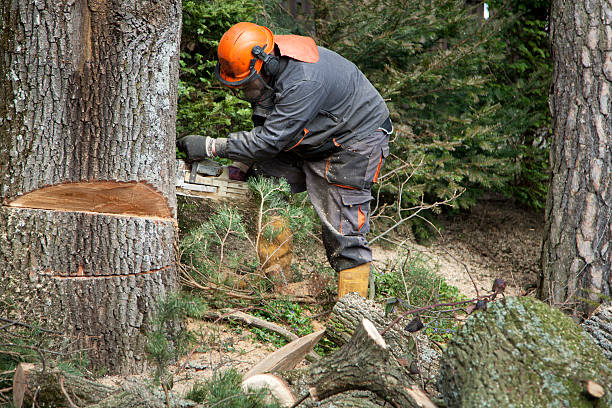
Our most common approach to removing a tree that has nearby residential structures, etc., involves our climber(s) ascending the tree and removing branches from top down, using specialized ropes and rigging equipment to lower each section, allowing for maximum control in the lowering process and minimizing potential damage to your residential structures, delicate landscaping, and/or surrounding utility lines.
Crane-Assisted Tree Removal
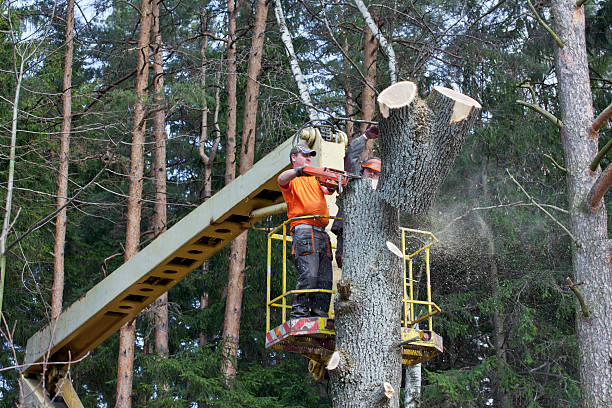
In cases involving very large trees, extremely proximity to residential structures (i.e., power lines), or a project that requires the utmost in precision, we offer crane-assisted removal. Utilizing a crane allows us to lift very large sections of the tree directly above the obstacle(s), providing extreme precision in placing the branch sections. Additionally, this will greatly reduce the risk factors involved in the removal process and oftentimes allow for completion of the removal much quicker than traditional climbing methods.
Straight Felling
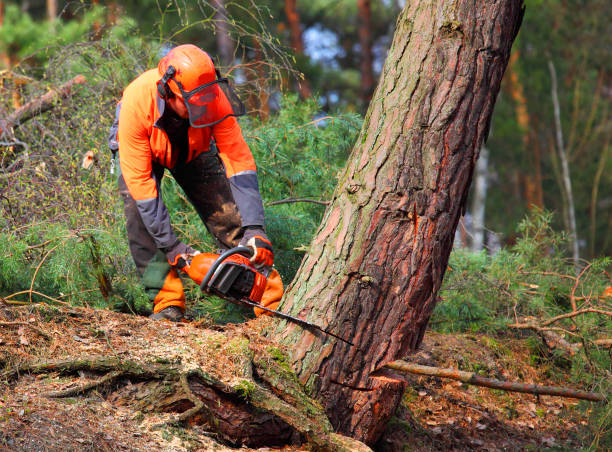
While not the preferred method due to the inherent risks, there are some occasions when a straight fall may be the quickest and most efficient way to remove a tree in an open field or large lot. Before felling the tree, we evaluate wind direction, tree weight, and lean to identify the safest place to position the tree to land. Following this evaluation, our arborist will strategically cut the tree, using high-quality wedges to ensure the tree falls exactly as anticipated.
Using Rigging to Remove Trees
If the tree is positioned over valuable landscaping, or if there is simply no “natural drop zone,” we will employ a series of specialized rigging systems to catch and redirect heavy limbs in mid-air. These rigging systems combine high-tensile ropes, pulleys, and friction-controlled devices to capture and redirect the tree limb and deliver it to a specified landing zone, thereby navigating through obstacles and delivering the tree sections to the desired area.